Open Forge / 13 releases / October 14, 2026
Thirteen Tools, Thirteen Releases: Every Greyforge Open-Source Tool, Improved
We went through every open-source tool Greyforge publishes and shipped a better version of each one. Thirteen tools, thirteen GitHub releases, all on October 14.
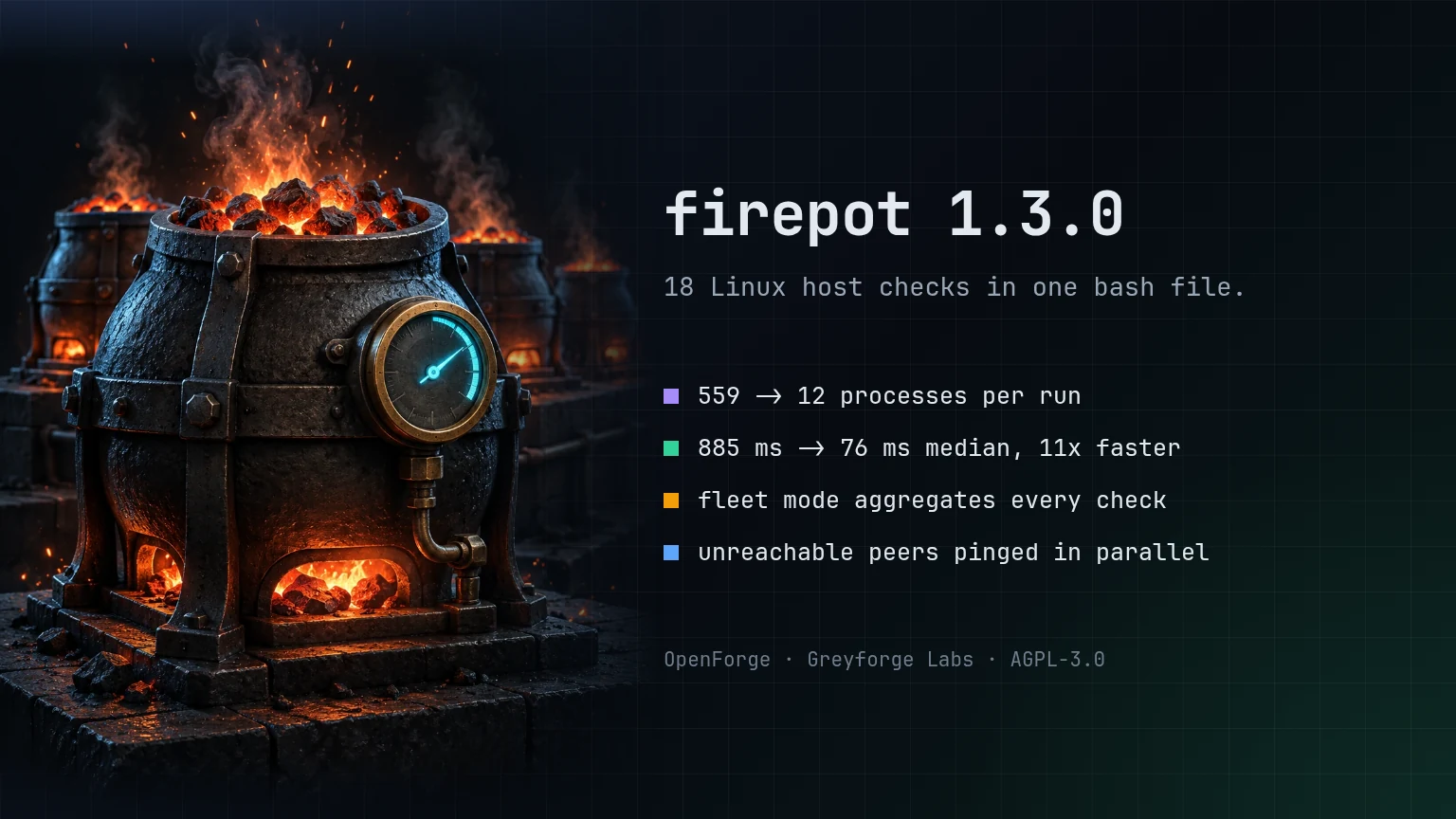
The biggest single change: firepot's full host check used to start 559 processes. It now starts 12.
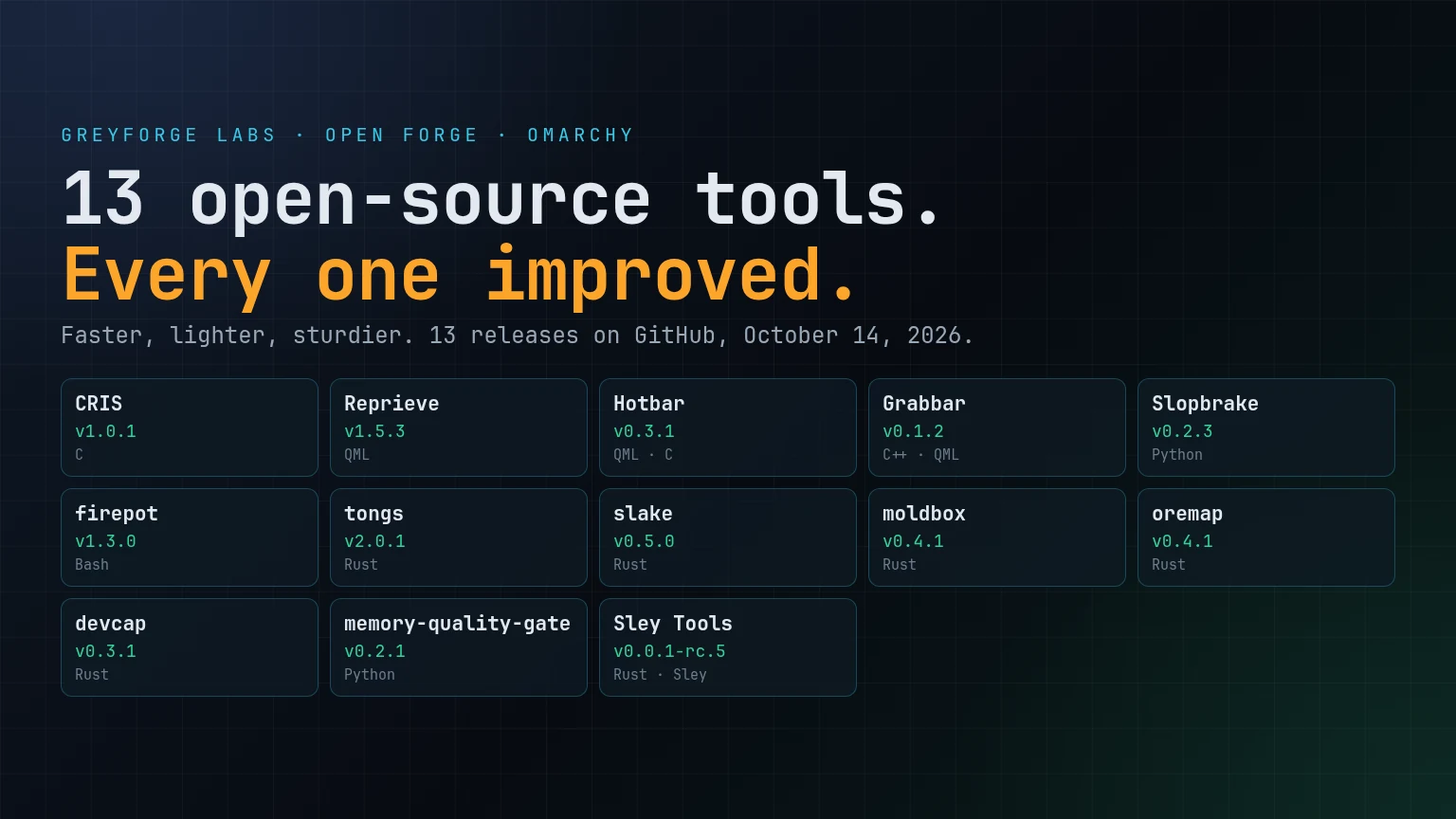
13
tools released
559 → 12
firepot processes
5,512 B
CRIS, unchanged
172 → 16
devcap threads
−27%
slake binary
0.055 ms
tongs lock hand-off
CRIS set the bar
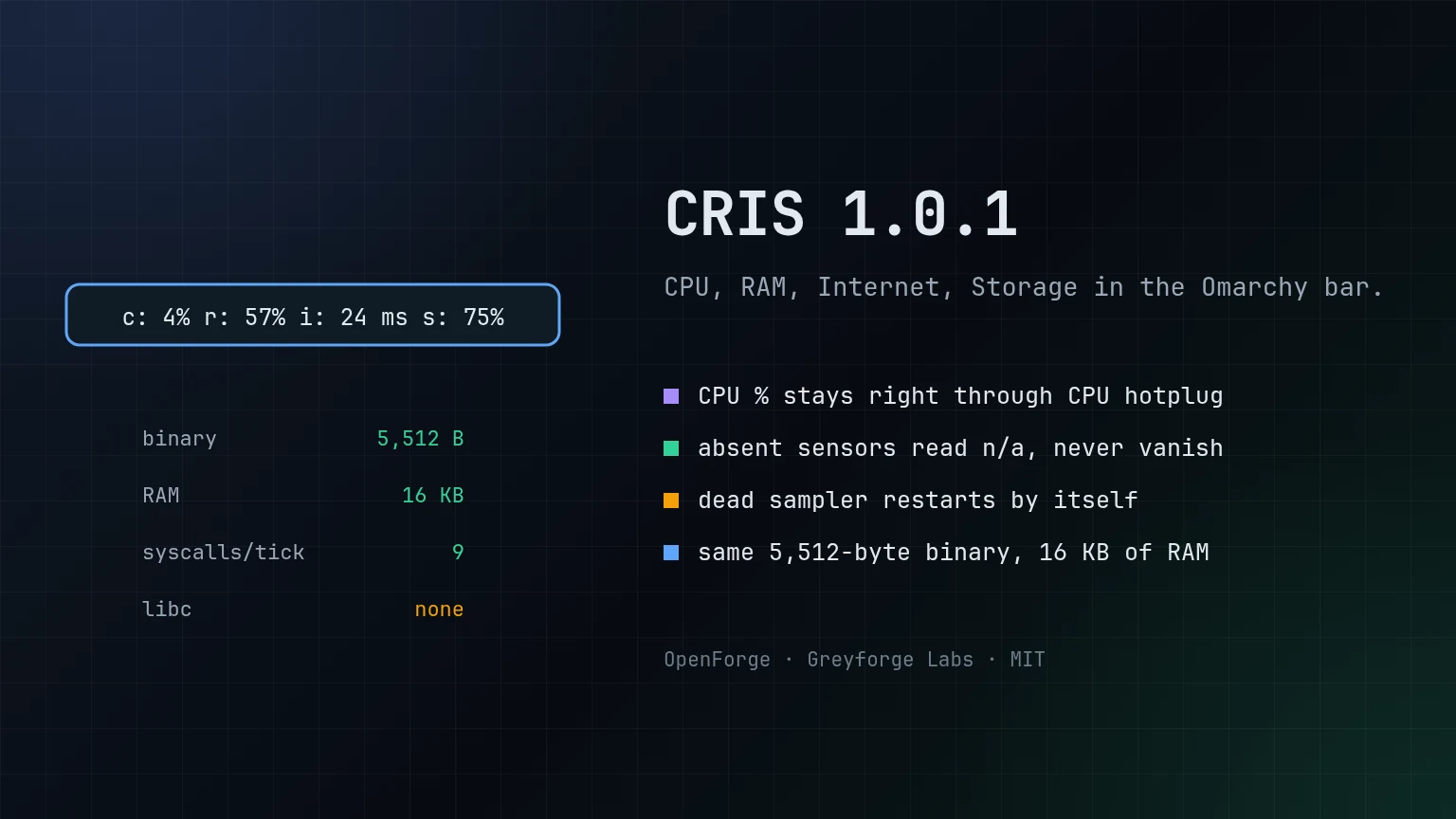
CRIS is the system monitor we wrote for the Omarchy bar in September. It is a C program with no libc that makes raw syscalls, sleeps between ticks and holds 16 KB of memory. Next to it, btop uses 32 MB.
The question for this sweep was simple: what would each of our other tools look like held to that standard? Less work per call, fewer processes started, fewer allocations, less code where the same job can be done with less, and every claim backed by a number measured on the same machine before and after.
CRIS went through the sweep too. It came out with four sampler fixes and a widget that restarts a dead sampler, and the binary is still exactly 5,512 bytes.
How each tool went through it
Each tool got its own fresh clone and the same written brief. Measure first. Fix bugs and cut work. Add a test for every fix that fails on the previous release. Measure again with the same method, interleaving old and new builds, because the host was busy and medians beat single runs. Then write it all down: numbers, method, what was left alone and why.
An independent review then read every diff and re-ran every suite. That pass earned its keep. It moved Grabbar's drag cancel out of a decoration destructor and into the plugin's exit hook, so nothing calls back into Hyprland while the compositor is tearing a window down. It had slake re-raise a stop signal after recording the run, so systemctl stop reads as a clean stop. It kept typing.get_type_hints() working on memory-quality-gate's public dataclasses.
The four Omarchy plugins were then loaded together in a nested Hyprland compositor on a headless output, with a sandboxed Omarchy shell and its own fake home directory. Grabbar's native plugin passed 19 startup checks and 16 interaction scenarios there. CRIS restarted its sampler 5.2 seconds after we killed it. Nothing ran on the live desktop.
Last came the release gate: a leak scan of every new line and commit message, CI green on the exact commit, then the tag and the release notes.
| Tool | What it does | What changed, measured |
|---|---|---|
| CRIS v1.0.1 | CPU, RAM, Internet and Storage in the Omarchy bar, from a libc-free C sampler. | Hotplug-safe CPU share, n/a for absent sensors, a sampler that restarts itself, one syscall fewer per tick. Still 5,512 bytes and 16 KB of RAM. |
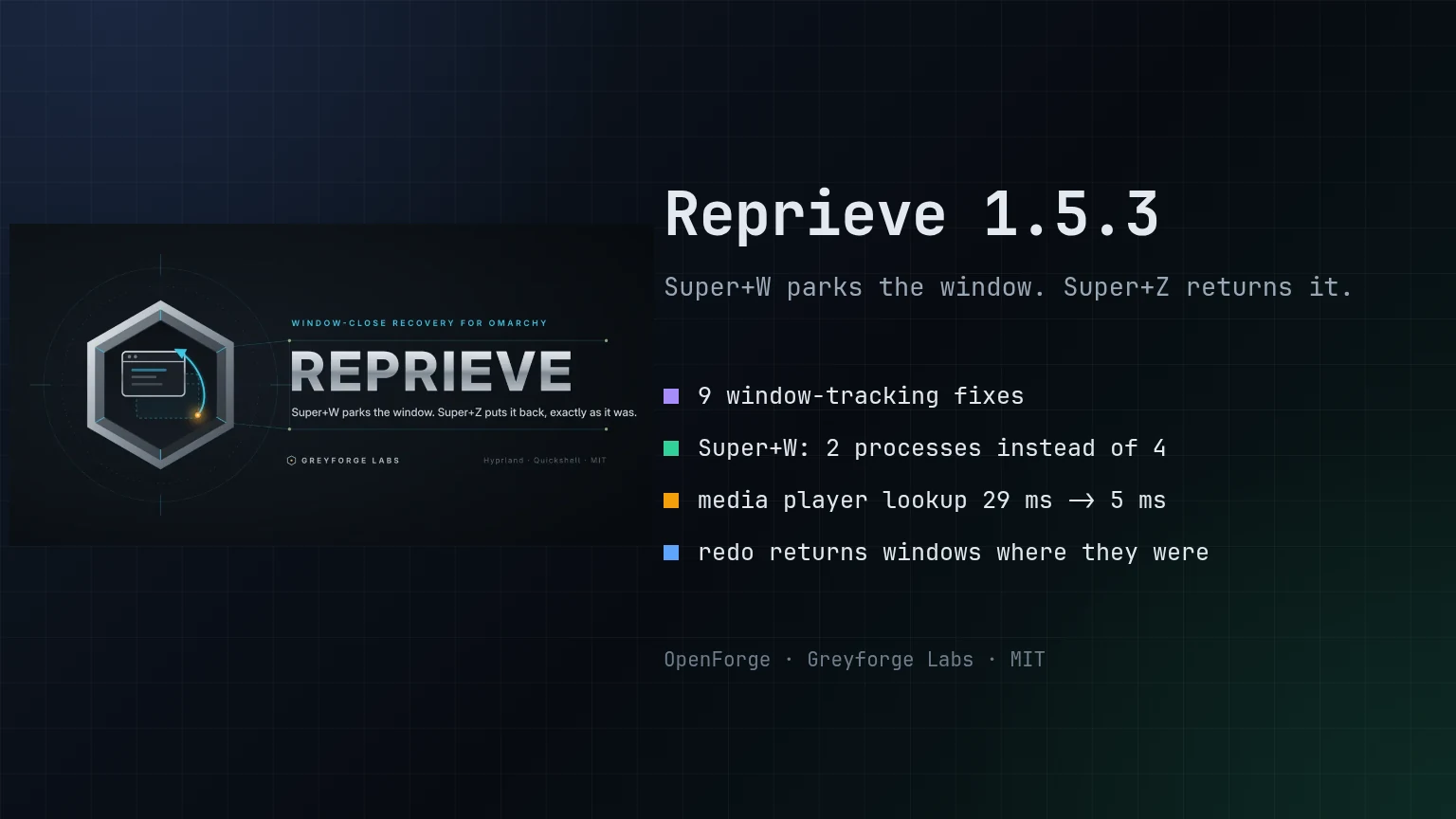
| Reprieve v1.5.3 | Super+W parks an Omarchy window instead of closing it; Super+Z brings it back. | Nine window-tracking fixes, 2 processes per Super+W instead of 4, media players found in 5.0 ms instead of 29.3 ms, 116 tests. |
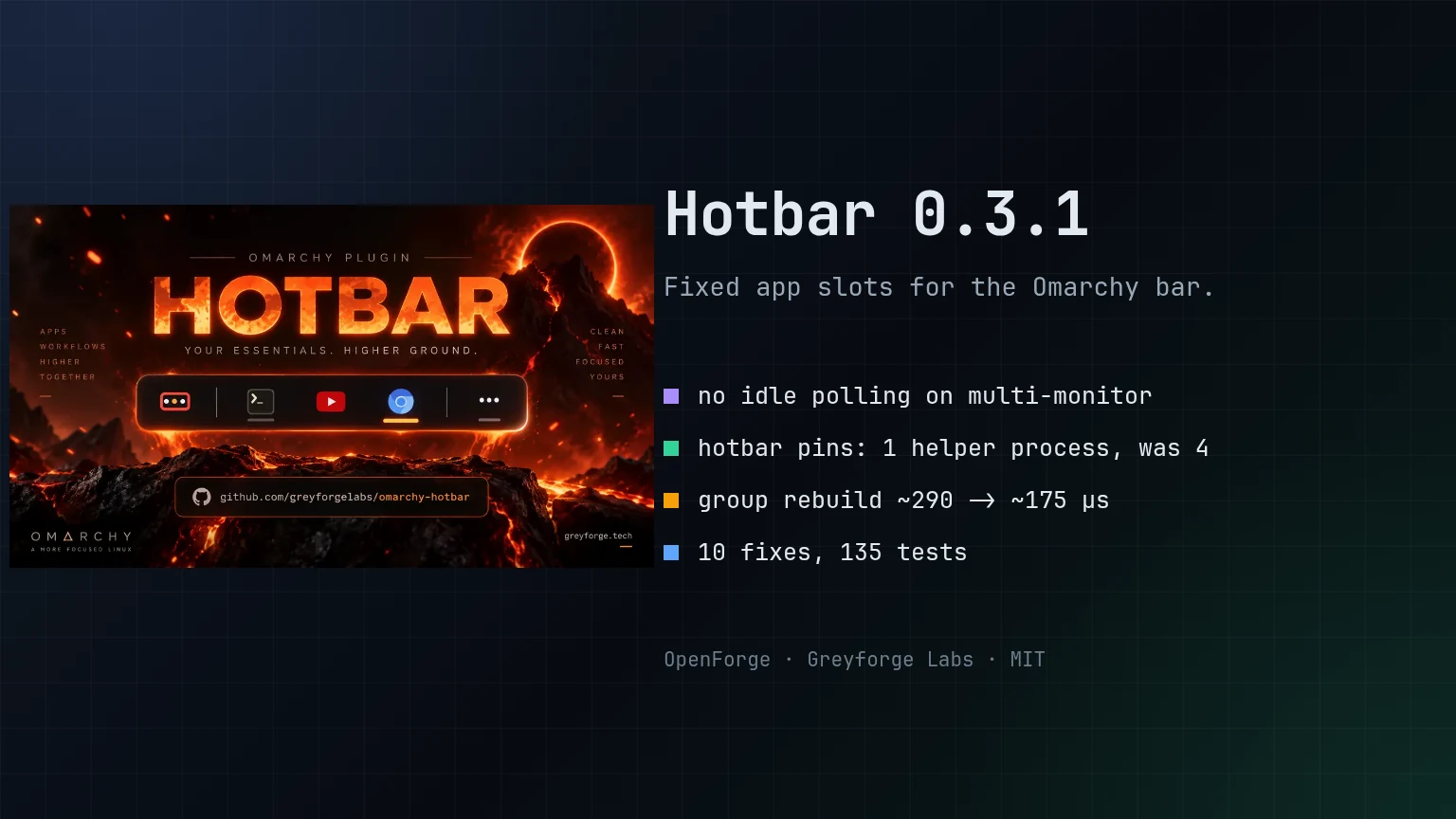
| Hotbar v0.3.1 | Fixed app slots, filesystem Places and one Running drawer for the Omarchy bar. | No idle polling on multi-monitor desktops, 1 helper process for hotbar pins instead of 4, group rebuilds in ~175 µs instead of ~290 µs, 135 tests. |
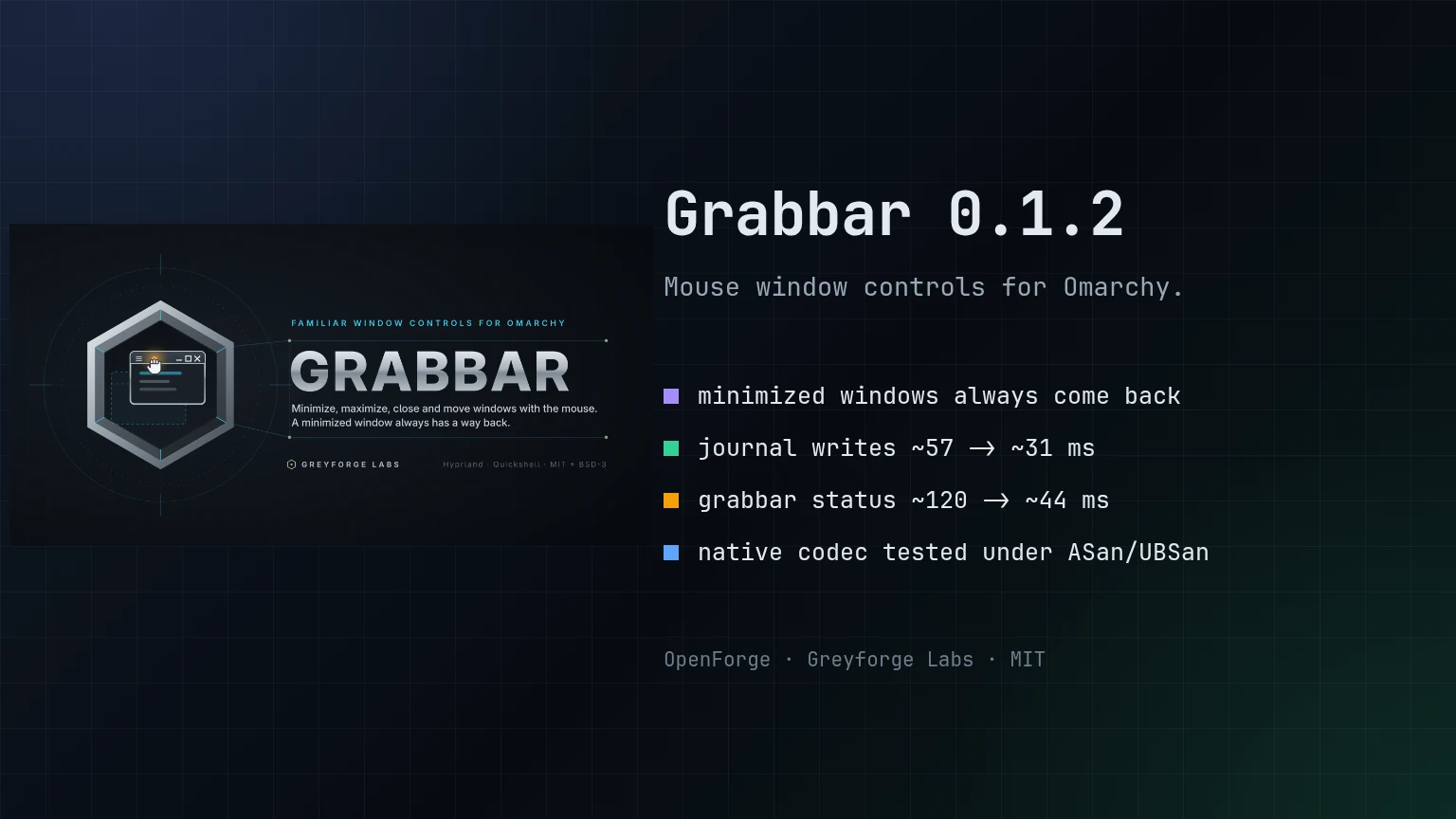
| Grabbar v0.1.2 | Minimize, maximize, close and move Omarchy windows with the mouse. | Minimized windows come back on unload, disable and restore-all; journal writes ~31 ms instead of ~57 ms; grabbar status ~44 ms instead of ~120 ms. |
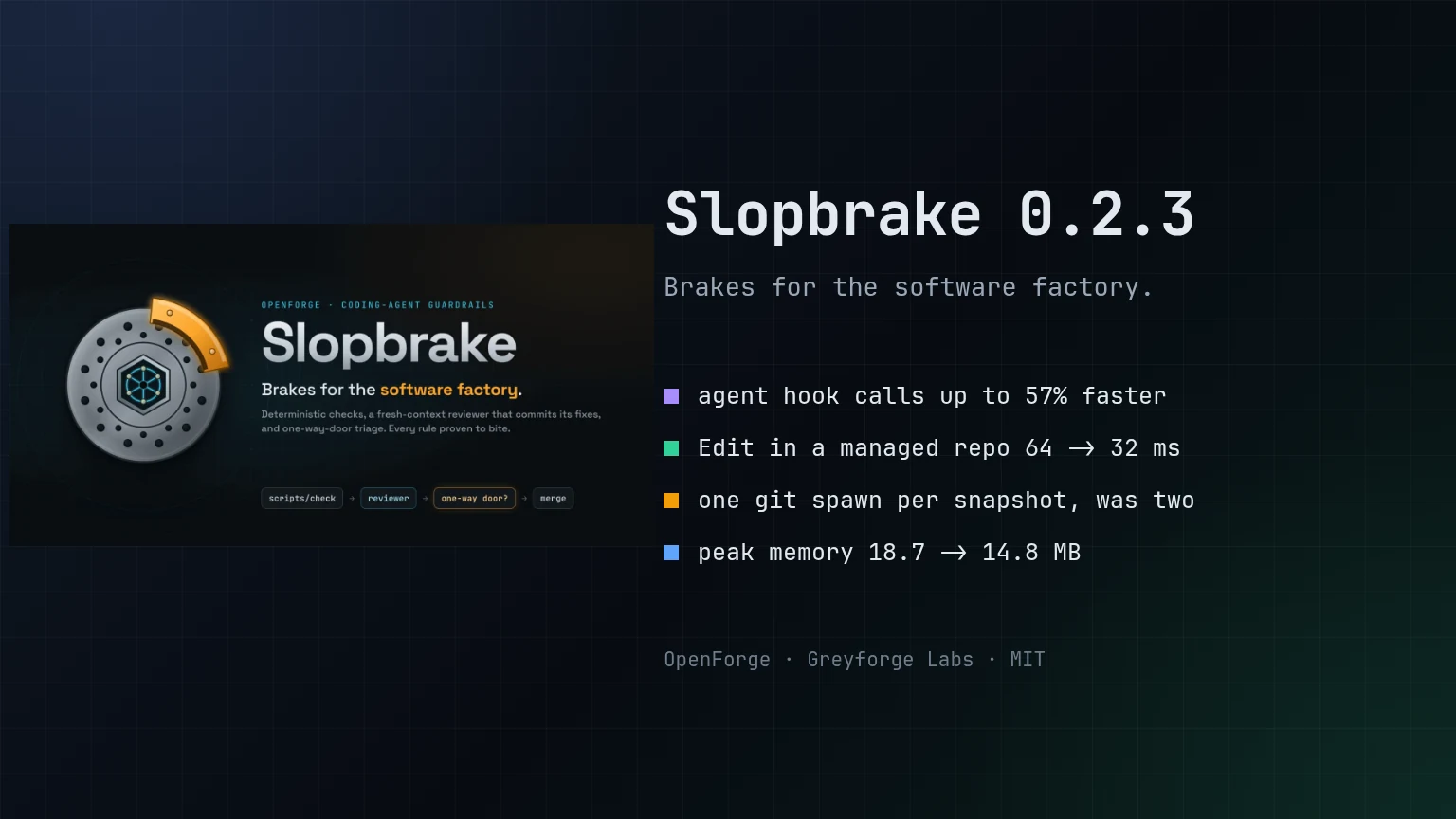
| Slopbrake v0.2.3 | Guardrails for coding agents, with hooks for Claude Code, Codex and OpenCode. | Hook calls 14 to 57% faster, an Edit in a guarded repo in 32 ms instead of 64 ms, peak memory 14.8 MB instead of 18.7 MB. |
| firepot v1.3.0 | Eighteen Linux host checks in one bash file, with JSON output and a fleet mode over SSH. | 12 processes per full run instead of 559, 76 ms instead of 886 ms, fleet mode aggregates every check, 203 tests. |
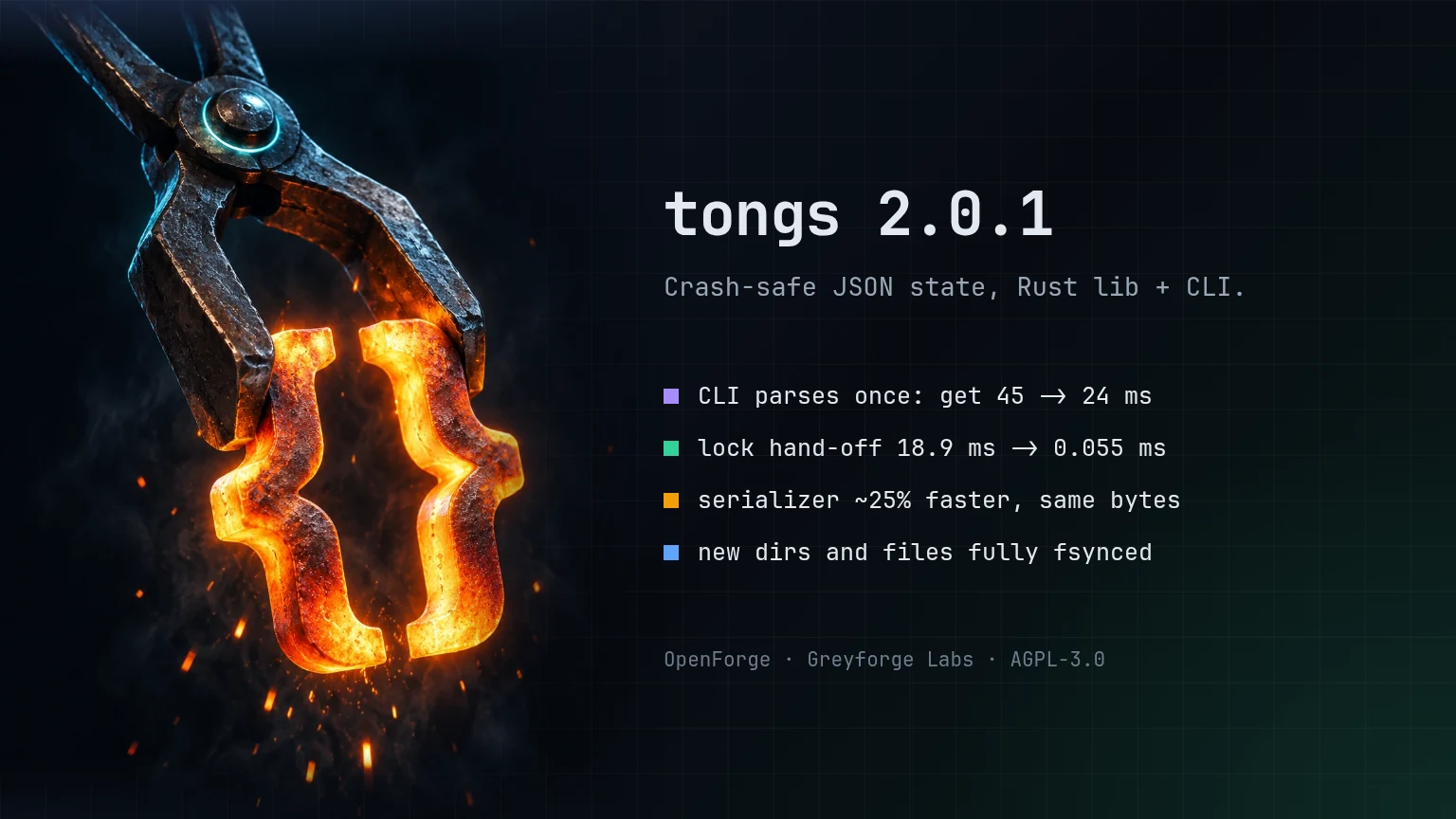
| tongs v2.0.1 | Crash-safe JSON state files: atomic writes, a cross-process lock, schema versions. | get on a 1.6 MB store in 24 ms instead of 45 ms, lock hand-off in 0.055 ms instead of 18.9 ms, serializer about 25% faster with identical bytes. |
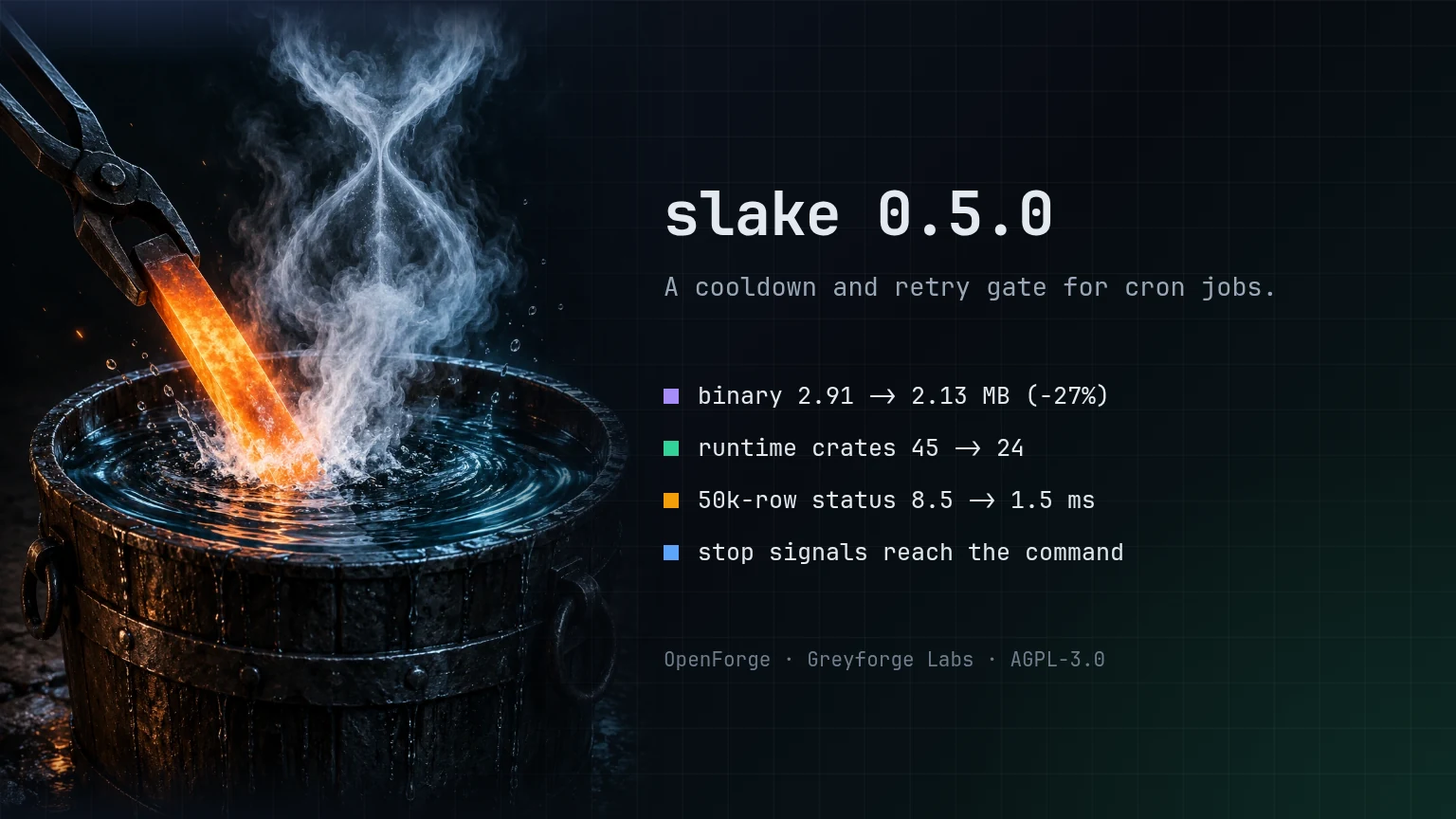
| slake v0.5.0 | A cooldown and retry gate for cron jobs and systemd timers, backed by a SQLite ledger. | 27% smaller binary, 24 runtime crates instead of 45, status on a 50,000-run ledger in 1.5 ms instead of 8.5 ms, stop signals relayed to the command. |
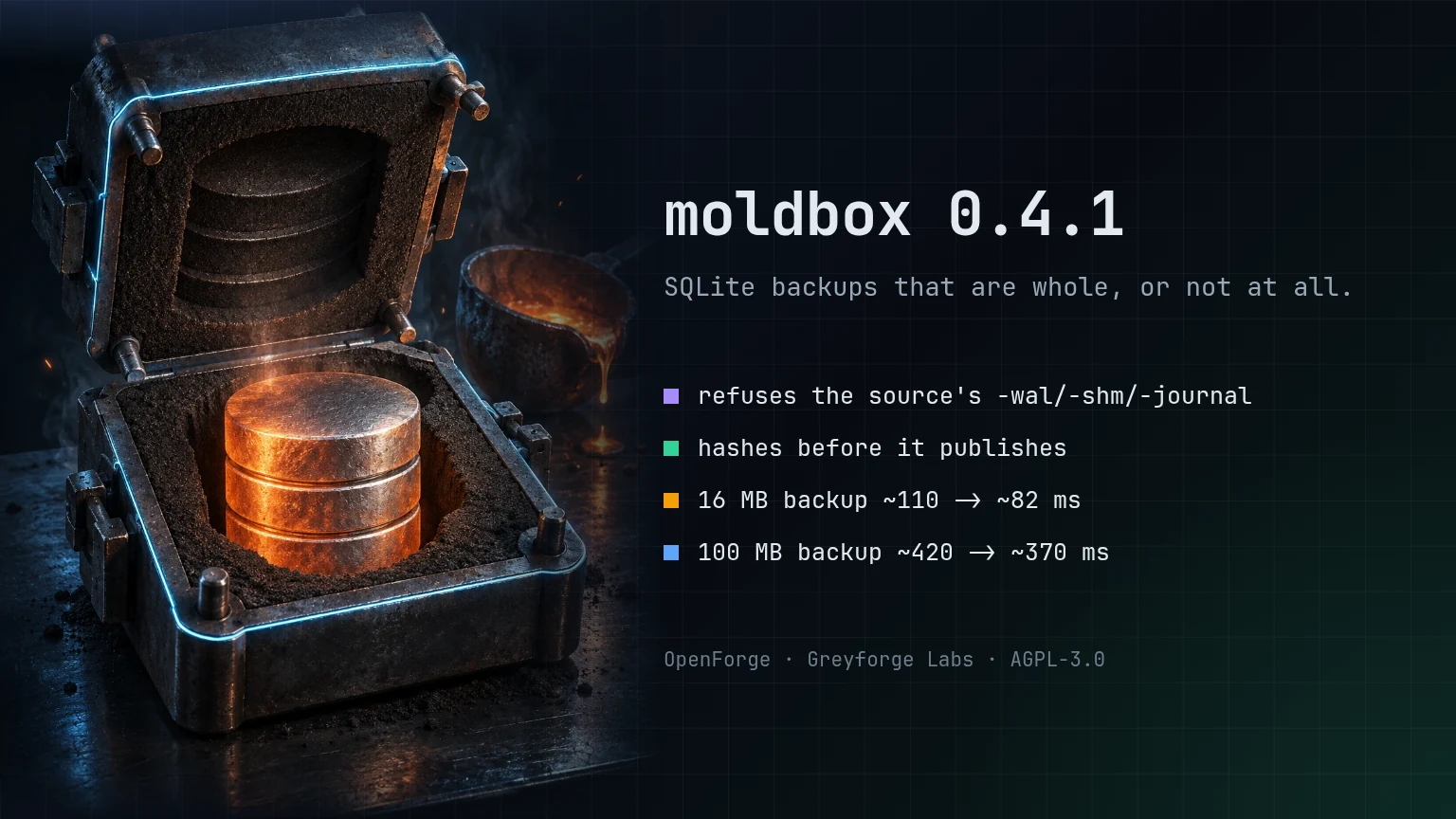
| moldbox v0.4.1 | SQLite WAL checkpoints, online backups and snapshots that are complete or not published. | Refuses destinations SQLite would treat as the source's -wal, -shm or -journal file, hashes before it publishes, 100 MB backups in ~370 ms instead of ~420 ms. |
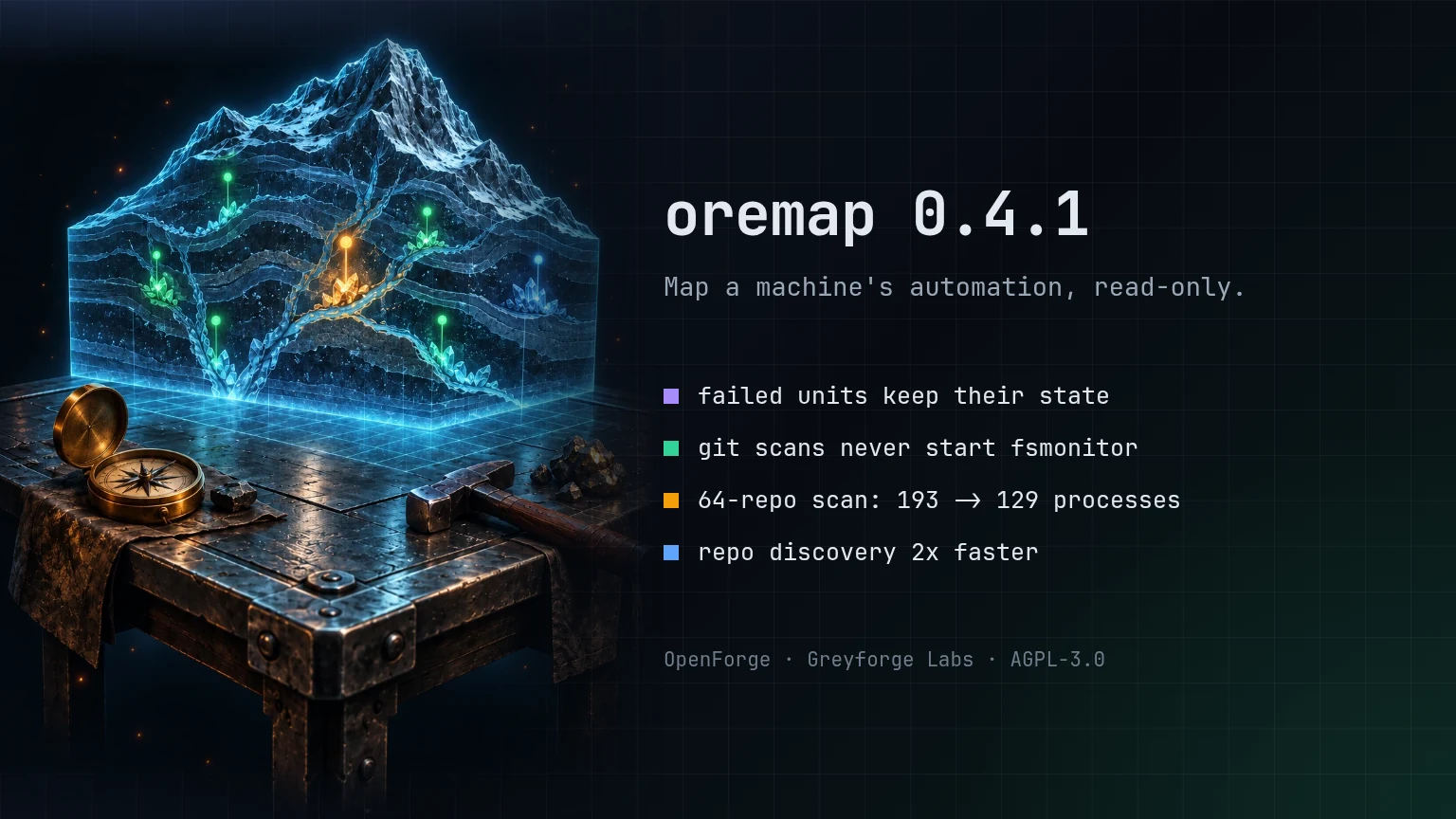
| oremap v0.4.1 | A read-only map of a machine's systemd units, timers, cron jobs, wrappers, repos and env-file names. | Failed units keep their state, git scans never start fsmonitor, a 64-repo scan launches 129 processes instead of 193, repo discovery twice as fast. |
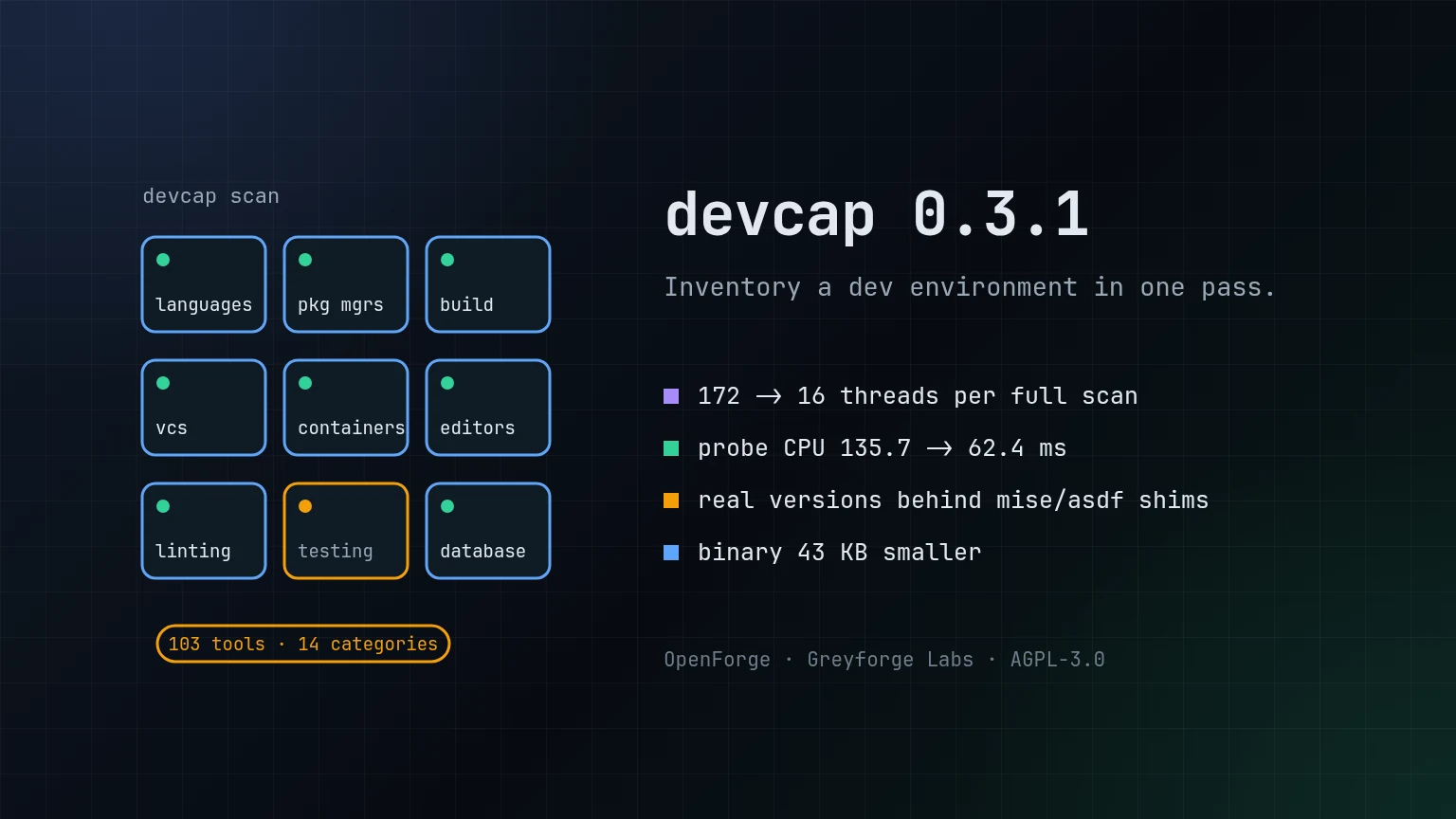
| devcap v0.3.1 | One scan that inventories a development machine's languages, package managers and tools. | 16 threads per scan instead of 172, probe CPU 62.4 ms instead of 135.7 ms, real versions for tools behind mise, asdf and pyenv shims. |
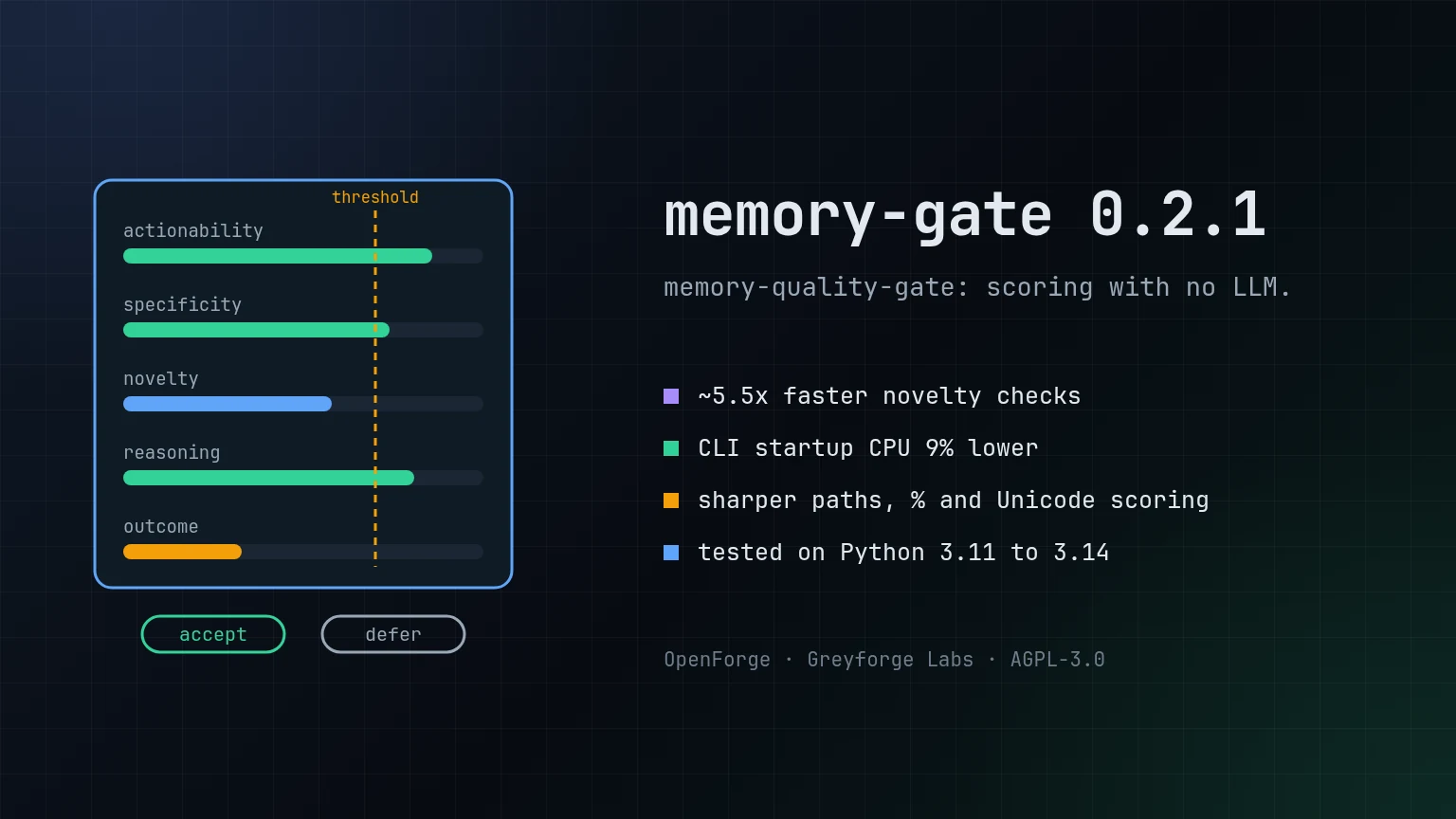
| memory-quality-gate v0.2.1 | Scores agent memory candidates before storage, with no LLM calls. | About 5.5 times more candidates per second against a corpus, sharper scoring for paths, percentages and non-ASCII text, CI on Python 3.11 to 3.14. |
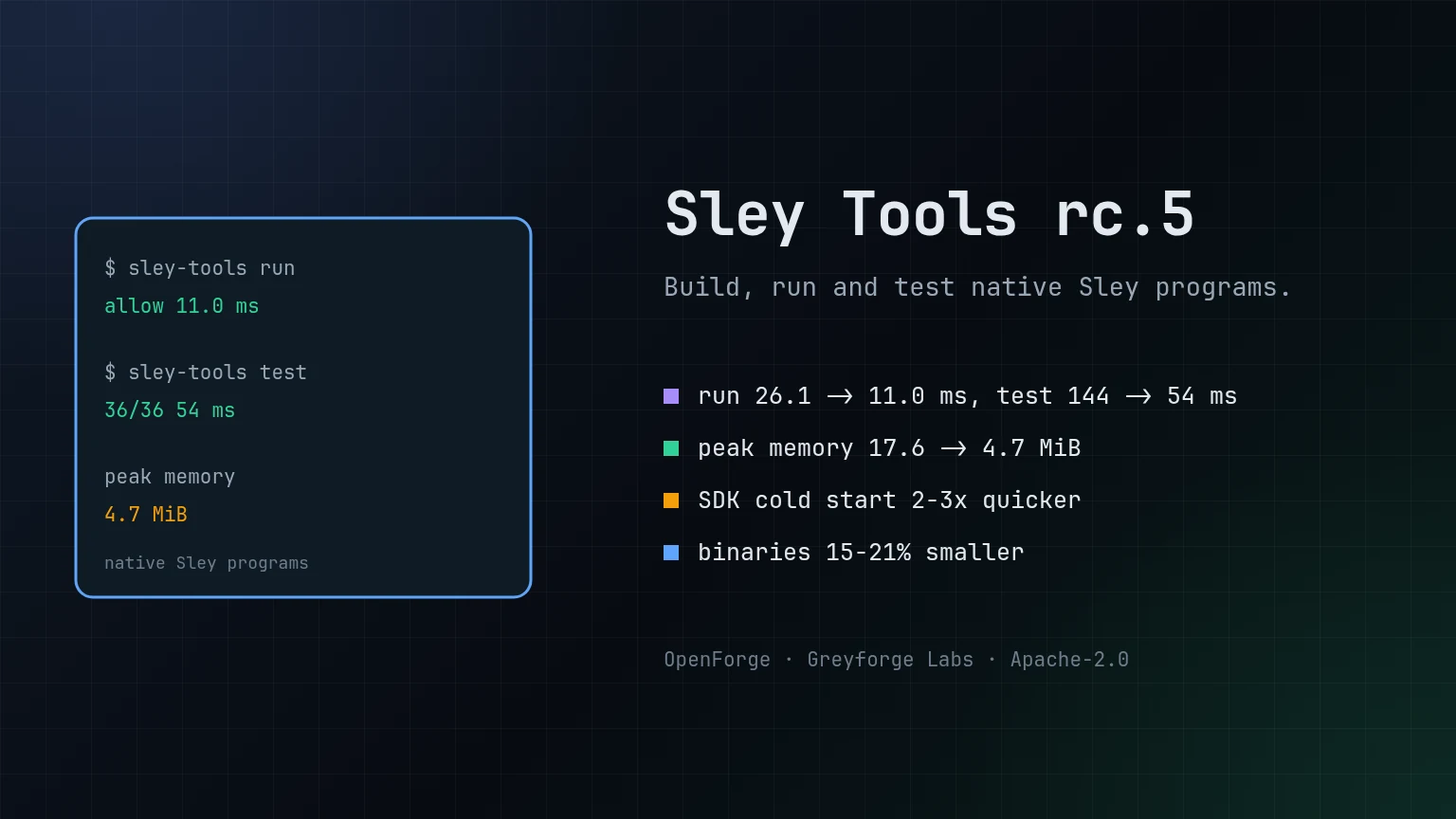
| Sley Tools v0.0.1-rc.5 | The toolkit for building, running, testing and sharing native Sley programs, with Python, TypeScript and MCP adapters. | run in 11.0 ms instead of 26.1 ms, test in 54 ms instead of 144 ms, peak memory 4.7 MiB instead of 17.6 MiB, binaries 15 to 21% smaller. |
The cost was in the processes
The same finding kept turning up in different languages: the expensive part of a small tool is usually the processes it starts, not the code it runs.
- firepot, a single bash script, forked subshells for every JSON escape, threshold and percentage. Doing that arithmetic in bash and reading
/procand/sysdirectly took a full run from 559 processes to 12 and from 886 ms to 76 ms. - Sley Tools ran its whole
doctorcheck, nine helper processes, before everyrun,testand edit. It now checks the core by path, pinned SHA-256 and manifest, which tookrunfrom 26.1 ms to 11.0 ms. - devcap started three helper threads per probe. One
poll(2)loop over the pipes and a Linux pidfd replaced them: 16 threads per scan instead of 172, and half the CPU. - Reprieve's Super+W path dropped from four processes to two, Hotbar's
hotbar pinsfrom four to one, and oremap's 64-repository scan from 193 to 129 by askinggit statusfor the branch and the changes in one call.
Parsing was the second theme. tongs read and parsed a store twice per CLI command and now reuses the first parse when the bytes under the lock are identical. slake ran seven statements and two table scans every time it opened its ledger; it now records its schema revision and runs one.
Dependencies were the third. slake swapped serde, serde_json and time for small built-in formatters with identical output and built its bundled SQLite without the features it never uses. Its runtime dependency tree went from 45 crates to 24 and its binary from 2.91 MB to 2.13 MB.
Omarchy plugins
The desktop tools got the most correctness work, because they track windows that Hyprland is free to move, close and renumber. Reprieve now drops a pending move when a window closes mid-flight, so a recycled address can never hide a new window, and redo returns a window to where it actually was rather than where it was first parked. Grabbar brings back every window on its hidden workspace when it unloads, even ones it has no record of. Hotbar maps a pin typed in the wrong case to the real app and treats names like constructor as ordinary keys.
All four install the same way, from GitHub through Omarchy's plugin manager. CRIS, for example: omarchy plugin add https://github.com/GreyforgeLabs/omarchy-cris --enable.
Data you can trust
Three of the tools exist to keep data intact, and each got stronger guarantees. moldbox now refuses to publish a backup under a name SQLite would treat as the source's own -wal, -shm or -journal file, and it hashes the synced file before publishing it. tongs sets a new file's mode through the open descriptor and fsyncs the parent of every directory it creates. oremap, which reads env files only to list variable names, now keeps every line of a multi-line value out of that list, PEM blocks included.
Every release card
Each card shows the release and the measured wins. Select one to open its release notes on GitHub.
Open Forge
Thirteen releases.
Source, notes and numbers on GitHub.
Every release lists its changes and the measurements behind them. If one of these tools runs on your machine, update it.