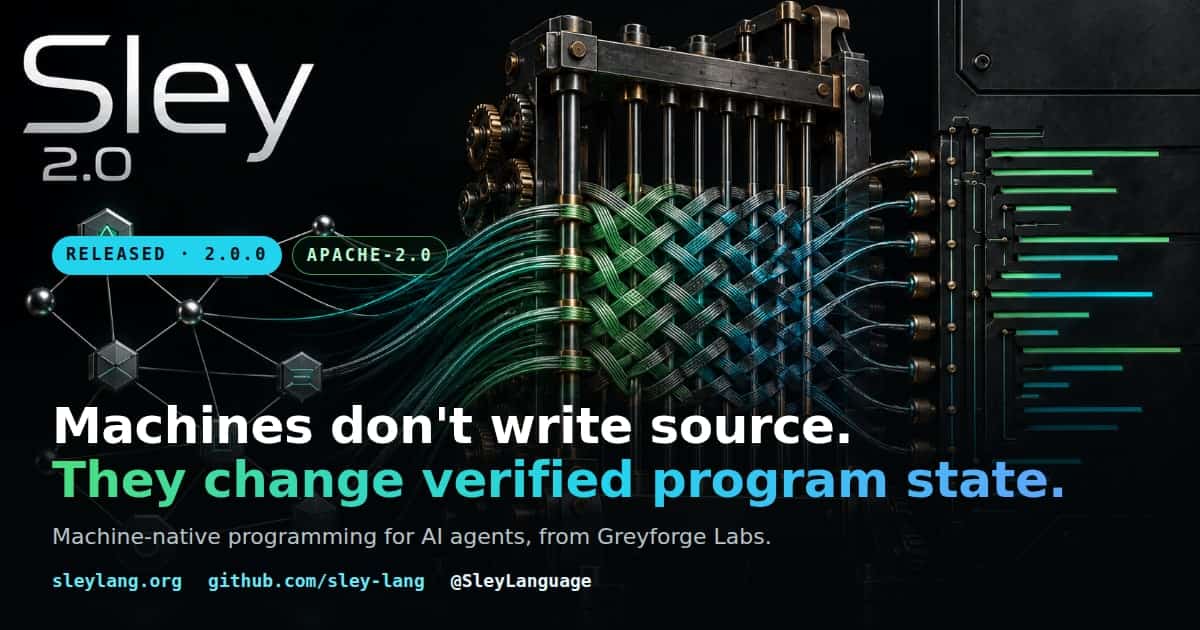
Sley 2.0 Is Here: Machine-Native Programming for AI Agents
Sley 2.0 is released under Apache-2.0: a programming system where AI agents change verified program state instead of writing source. Here is what it took to ship.
Releases, experiments, and life with Linux.
56 Chronicles
Sley 2.0 is released under Apache-2.0: a programming system where AI agents change verified program state instead of writing source. Here is what it took to ship.

From Slackware in 1997 to Omarchy in 2026: first impressions of returning to Arch after fourteen years in Debian land.
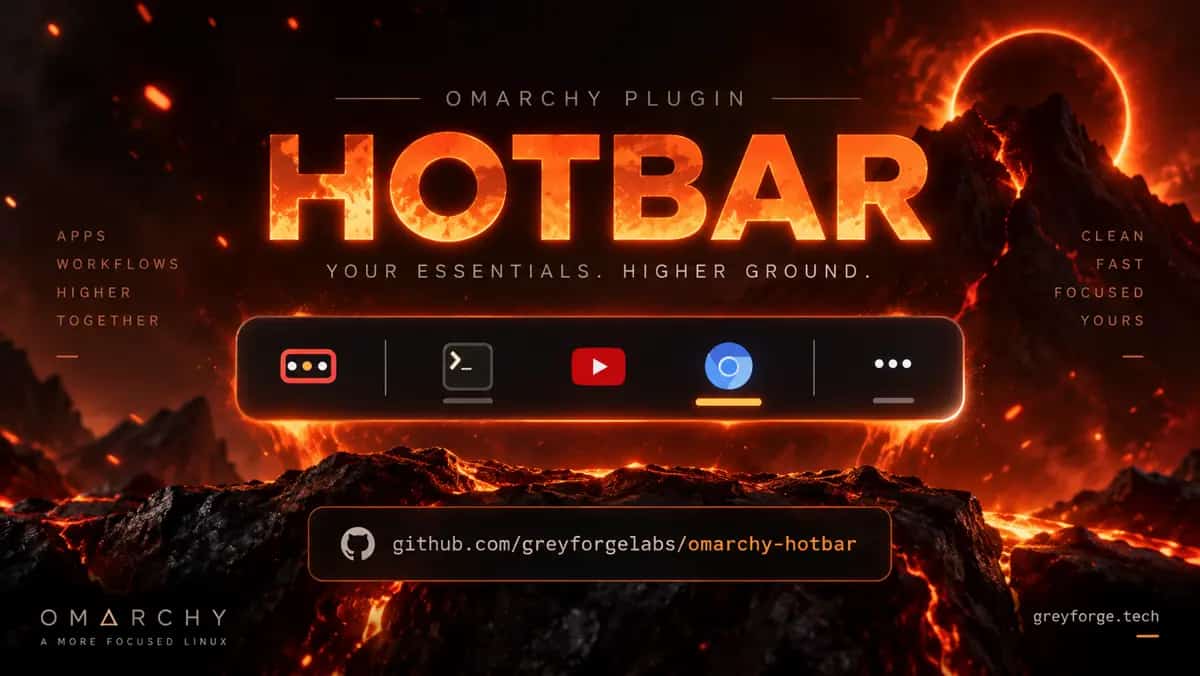
HOTBAR keeps pinned apps in place and everything else in one Running drawer. A small, free addition to the Omarchy desktop.
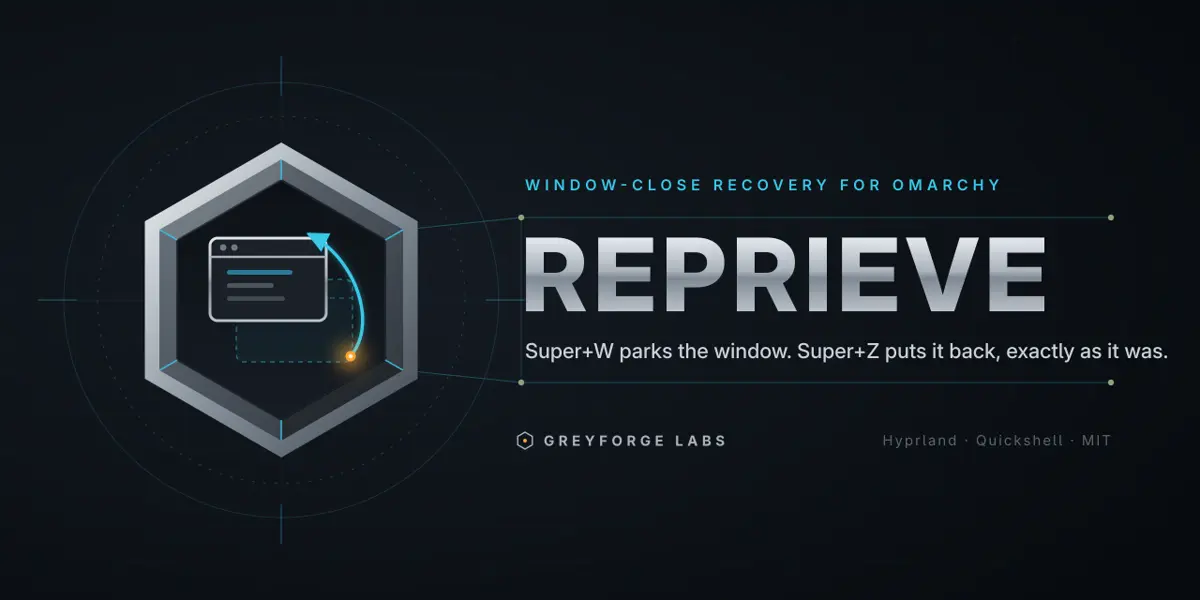
Park a window with Super+W. Bring it back with Super+Z. Reprieve adds a safety net and recovery timeline to Omarchy.
ZJX 1.29.0 adds the ultrafast objective beside compact and fast, qualifies it on two separately reported cohorts, and discloses the thin held-out margin and everything the release did not achieve.
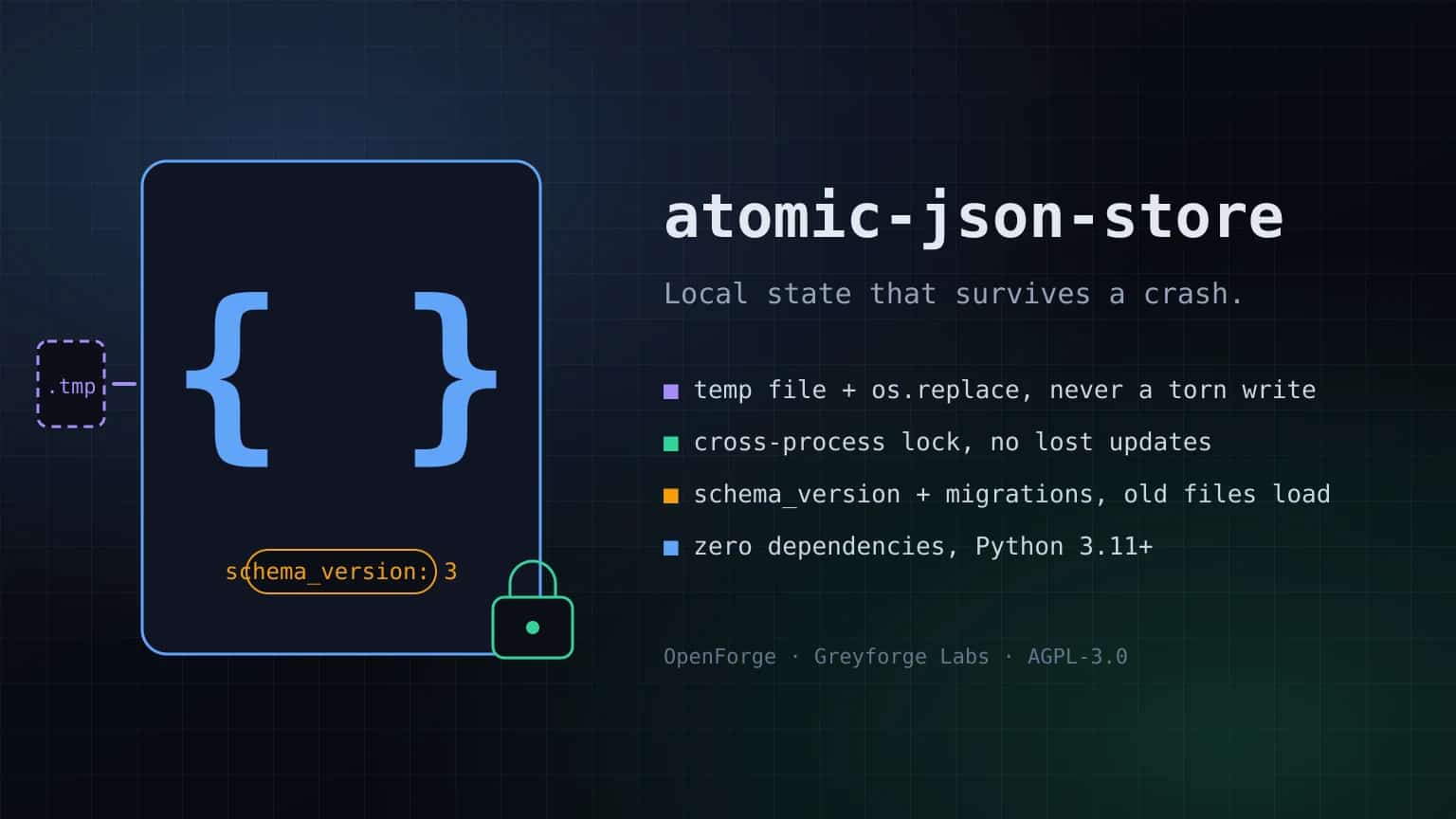
Why Greyforge Labs released atomic-json-store, a zero-dependency Python library that makes a JSON state file safe to interrupt, safe to share between processes, and safe to upgrade through schema migrations.
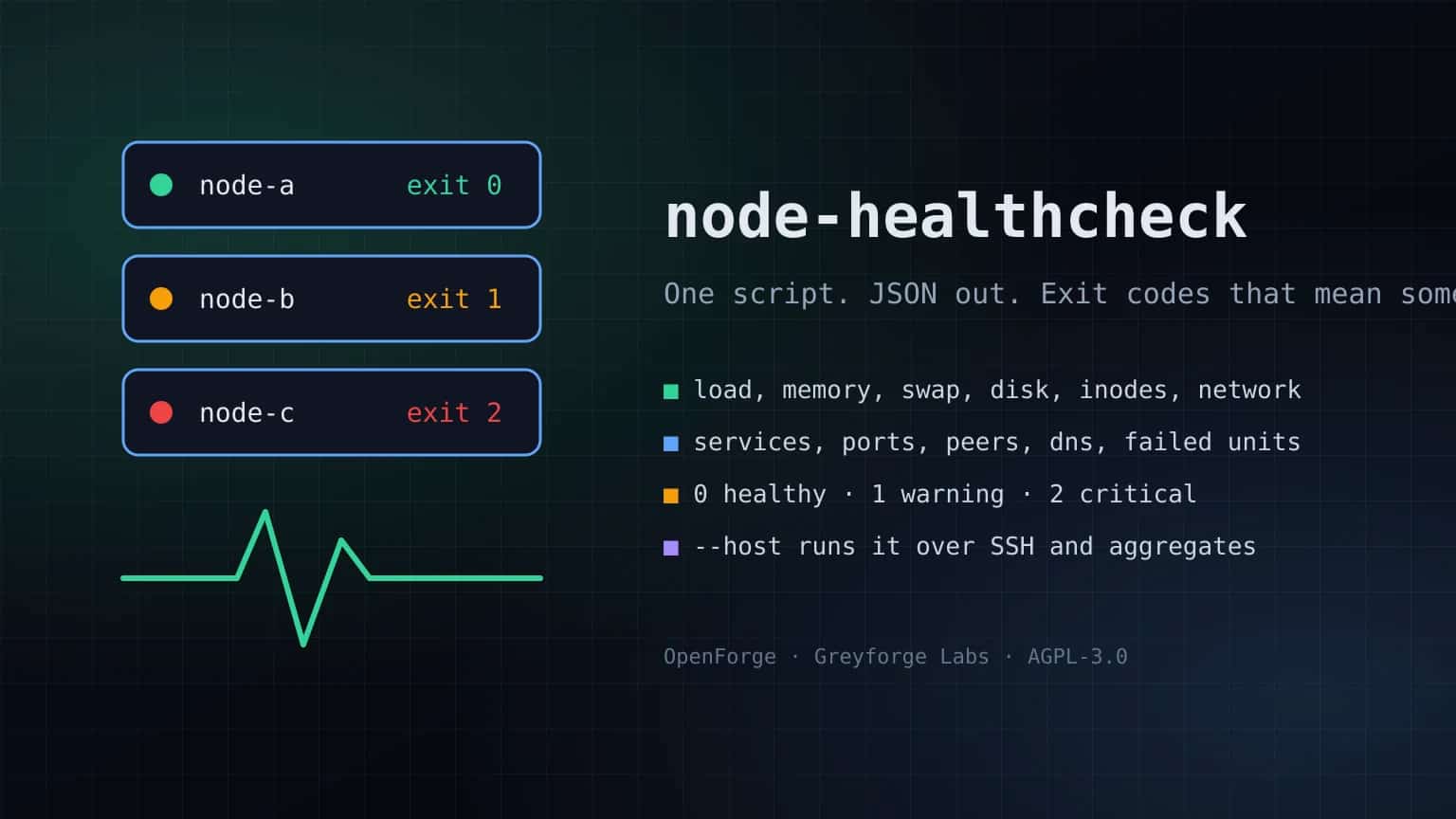
Why Greyforge Labs released node-healthcheck, a single bash script that runs eighteen host checks, emits JSON without jq, exits 0, 1, or 2, and aggregates a fleet over SSH with nothing installed remotely.
The encrypted-archive architecture behind ZJX 1.27: protected names, explicit trust boundaries, and the evidence required before qualification.
ZJX 1.28.0 completes its supported Linux archive workflow with member selection, protected archives, safe restoration, and a relocatable package.
ZJX 1.26 RELICWIRE recovered a mechanism from a campaign already closed as a terminal failure, measured about 28% and 43% lower wall time and CPU on two large corpora, and was blocked by its own internal audit until two evidence defects were repaired. The findings and reproduction record require an unlock.
ZJX 1.25.1 NIGHTMARKET ships two explicit packing objectives. Under a frozen four-corpus clean-lab campaign, fast packed in about 36 percent of compact's wall time with zero size penalty, while the quickest evaluated schedule was rejected for exceeding downstream cost limits. The rejected-schedule analysis, measurement-law repairs, and clean-lab doctrine require an unlock.
ZJX 1.24 GHOSTLANE won four of four paired comparisons with a 22.35% median improvement, then failed repository-wide validation and was not released. The failure analysis and release doctrine require an unlock.
ZJX 1.22 NULLSPOOL preserved archive correctness but failed end-to-end wall-time and CPU qualification, so it was rejected and not shipped. Reported figures, qualification analysis, and lessons require an unlock.
ZJX 1.23 BLACKWIRE establishes native canonical binaries, clean-host operation, exact archive identity, and one qualified production boundary. The invalid-campaign analysis, harness repairs, and transferable release doctrine require an unlock.
How historical ZJX 1.21 completed Silesia at about 390 MB peak encode memory after the earlier run failed at 8.58 GB, with exact restoration and archive compatibility checked separately.
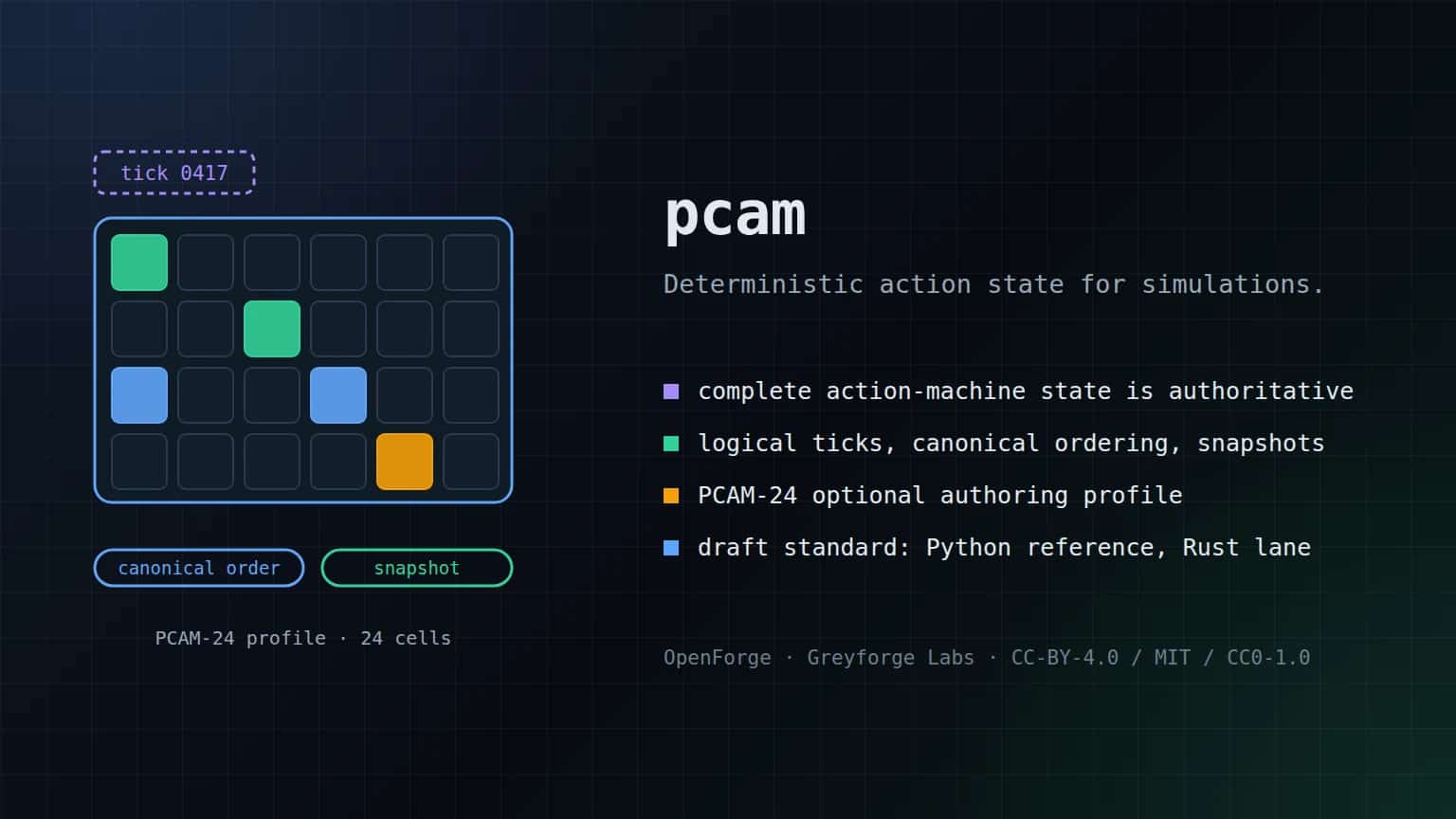
PCAM v3 advances to a Normative Candidate by replacing phase-only authority with complete action-machine state, logical ticks, explicit release gates, and zero conformance claims.

Sley 1.2.0 keeps Greyforge's human-readable 1.x line open while current research attention turns toward the machine-native Sley 2.x thesis.

Sley 1.2.0 moves Greyforge's self-hosted structural programming language to a public release-candidate boundary with expanded proof, Linux x86_64 artifacts, and explicit production limits.

The premium infrastructure record on bounded archive decoding across expansion, child processes, temporary storage, dependency readiness, paths, and failure evidence.

How ZJX moved beyond ratio claims toward an archive lifecycle built on validated bundles, dependency readiness, no-write restore planning, lower-memory routing, and fail-closed decoder behavior.

How Sley evolved into a bounded review surface where staged bytes, read-only tool access, report-only semantic comparison, and human authority remain separate decisions.

How ZJX turns compression claims into evidence: selected verifier-checked size wins including review-gated 160 MB JSONL, 256 MB sharded NDJSON, and 1.1 GB compact JSONL validation bundles with a scoped no-zpaq follow-up, local telemetry rows up to 1.25 GB, review-gated evidence records, validation checks, and strict claim boundaries.

How Sley, an agent-native structural programming language, and ZJX, an evidence-first lossless archive prototype, work together to reduce repeated context, speed developer workflows, and make code change more reliable.

A personal account of moving from hand-built websites to delegated engineering: what the author wants to automate, what still needs judgment, and the atrophy tax.

How Greyforge turned open source releases from scattered repo chores into a gated release engine with audits, scrub passes, and publish discipline.

The premium operator edition on turning open source ideas into gated repositories, release evidence, public proof, and disciplined multi-repo execution.
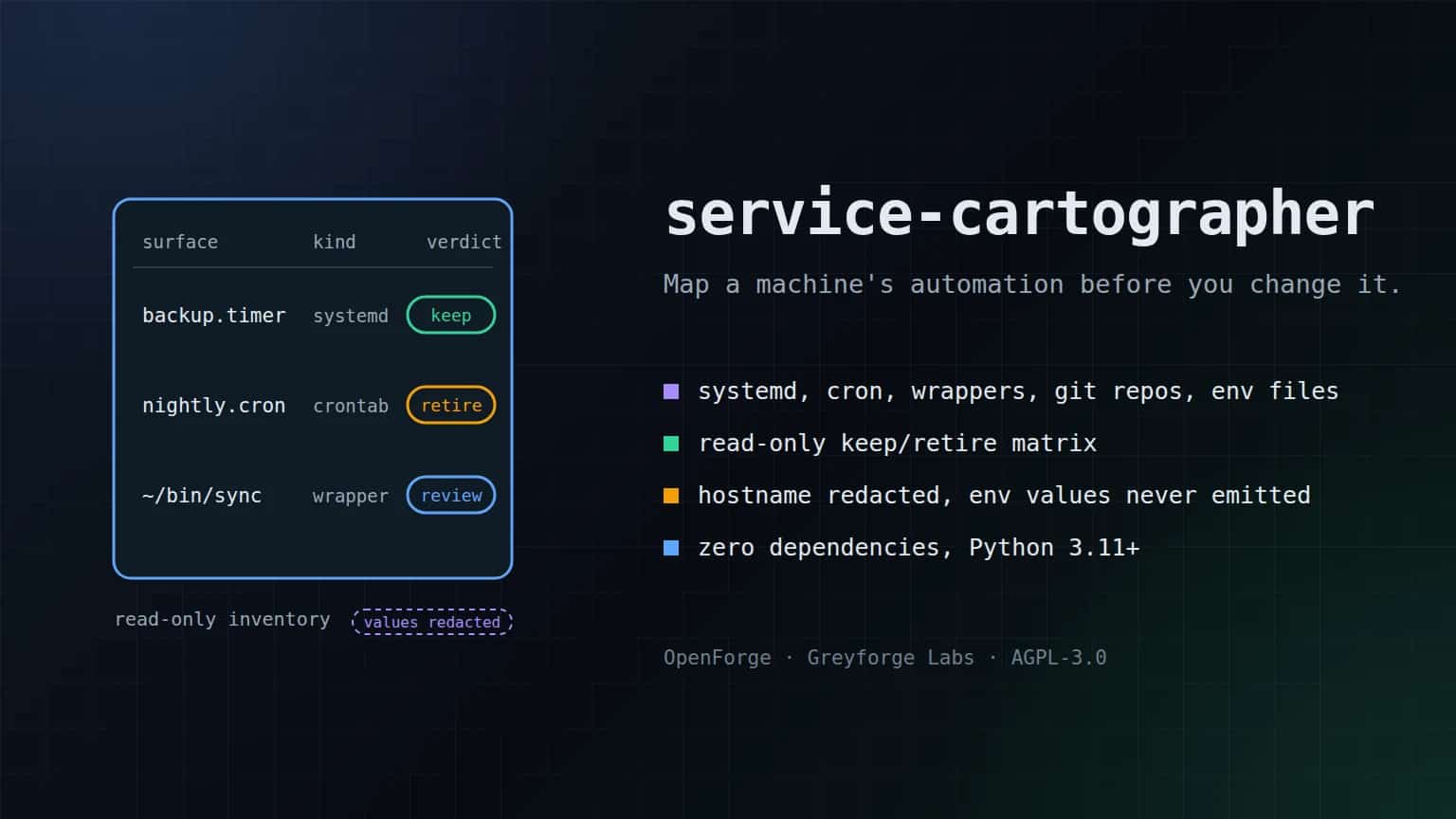
Why Greyforge released service-cartographer, a read-only OpenForge utility for mapping local services, cron jobs, wrappers, repositories, and env-file metadata before cleanup begins.

A spring-2026 account of organizing video production into reviewable packets, with the internal production lane distinguished from the public workflow kit.

An April 2026 operator account of a disputed Grok access boundary, with the missing evidence and limits of a chatbot concession made explicit.

A Chronicle on ForgeNode, ForgeHub, Forge CLI, WebForge, ForgeVideo, and the governed code, media, and content factory taking shape inside Greyforge.

A public technical note on why Greyforge does not plan to adopt karpathy/autoresearch and what matters more in serious research architecture.
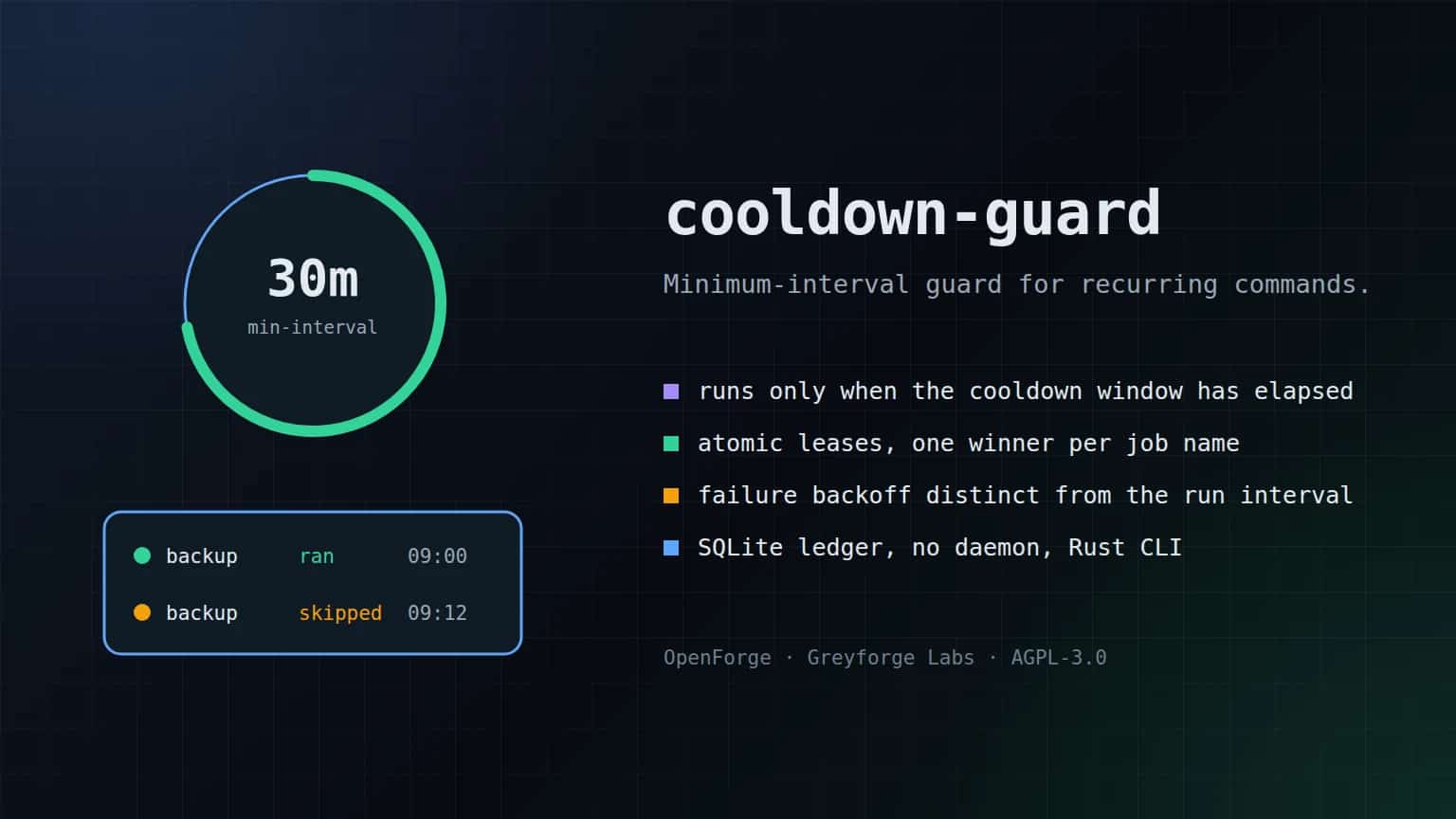
A practical release pattern for preventing repeat-triggered automation bursts by enforcing per-key cooldown windows in a SQLite-tracked policy engine.

Why Greyforge retired ForgeClaw from the public catalog, aligned more day-to-day work with upstream OpenClaw, and kept the custom orchestration layer private.
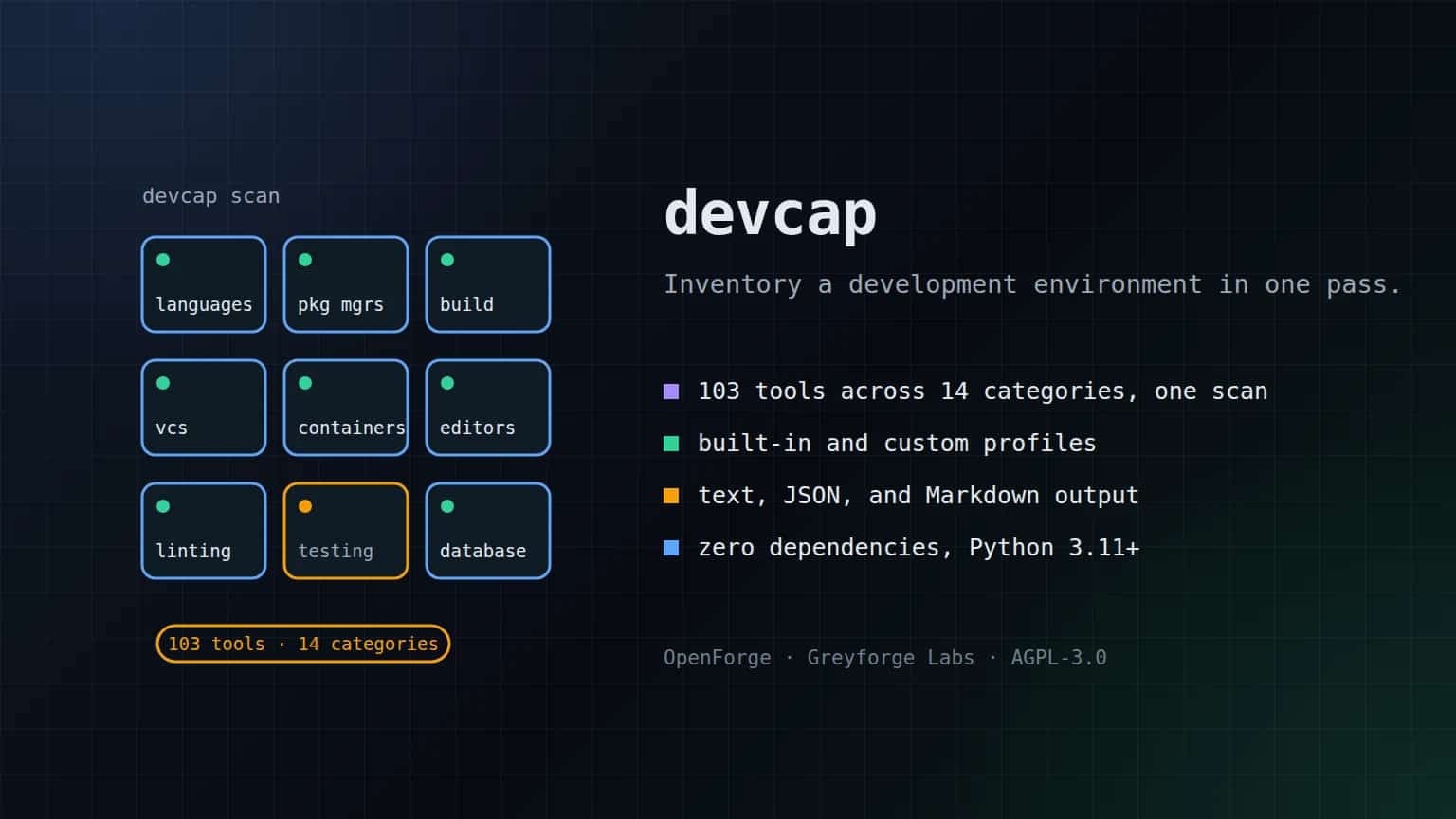
Why Greyforge Labs built devcap - a zero-dependency Python CLI that audits 100+ tools across 14 categories with parallel scanning and structured output.
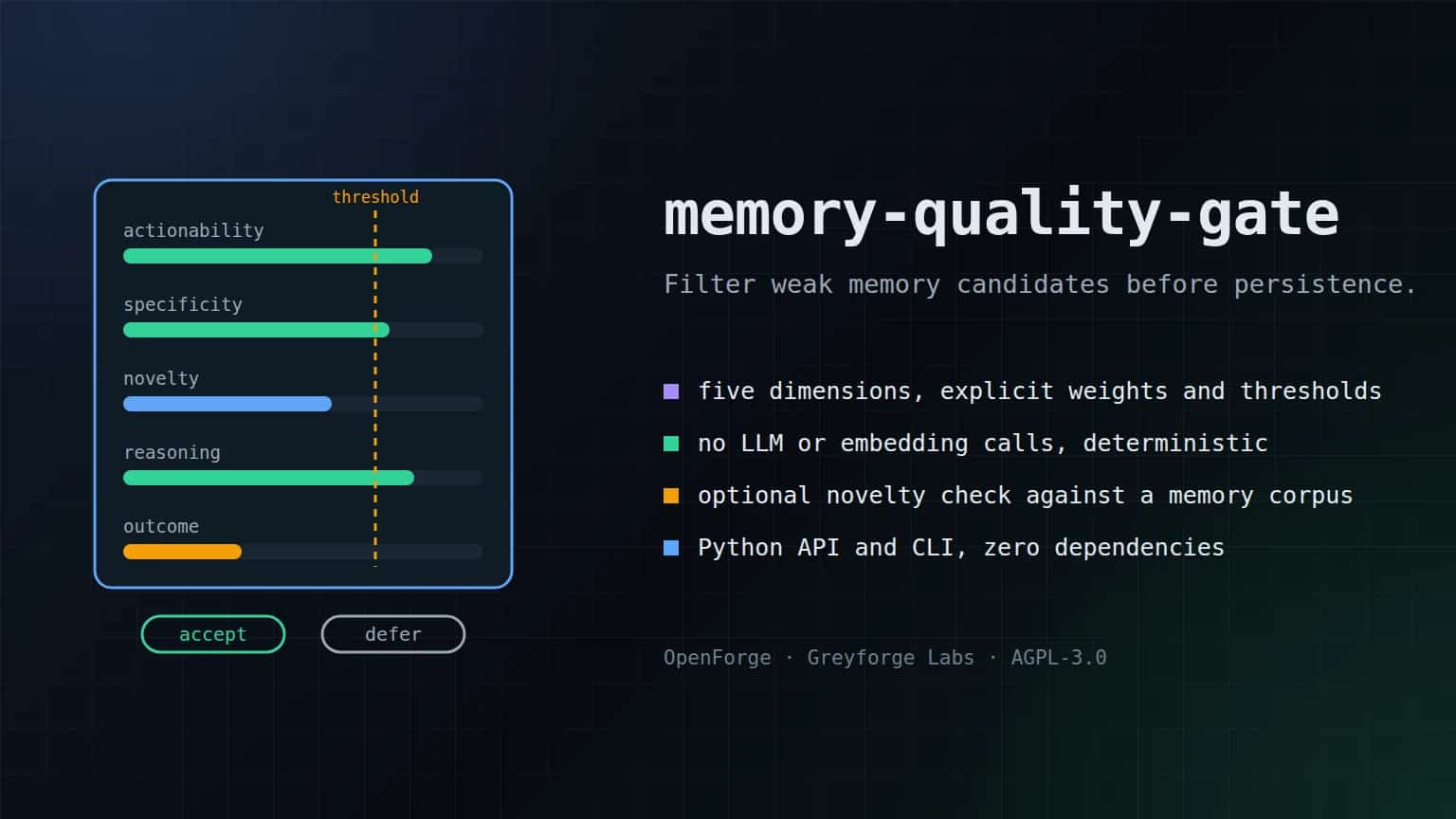
Why Greyforge Labs released memory-quality-gate, a zero-LLM heuristic filter that scores candidate memories before they hit long-term storage.
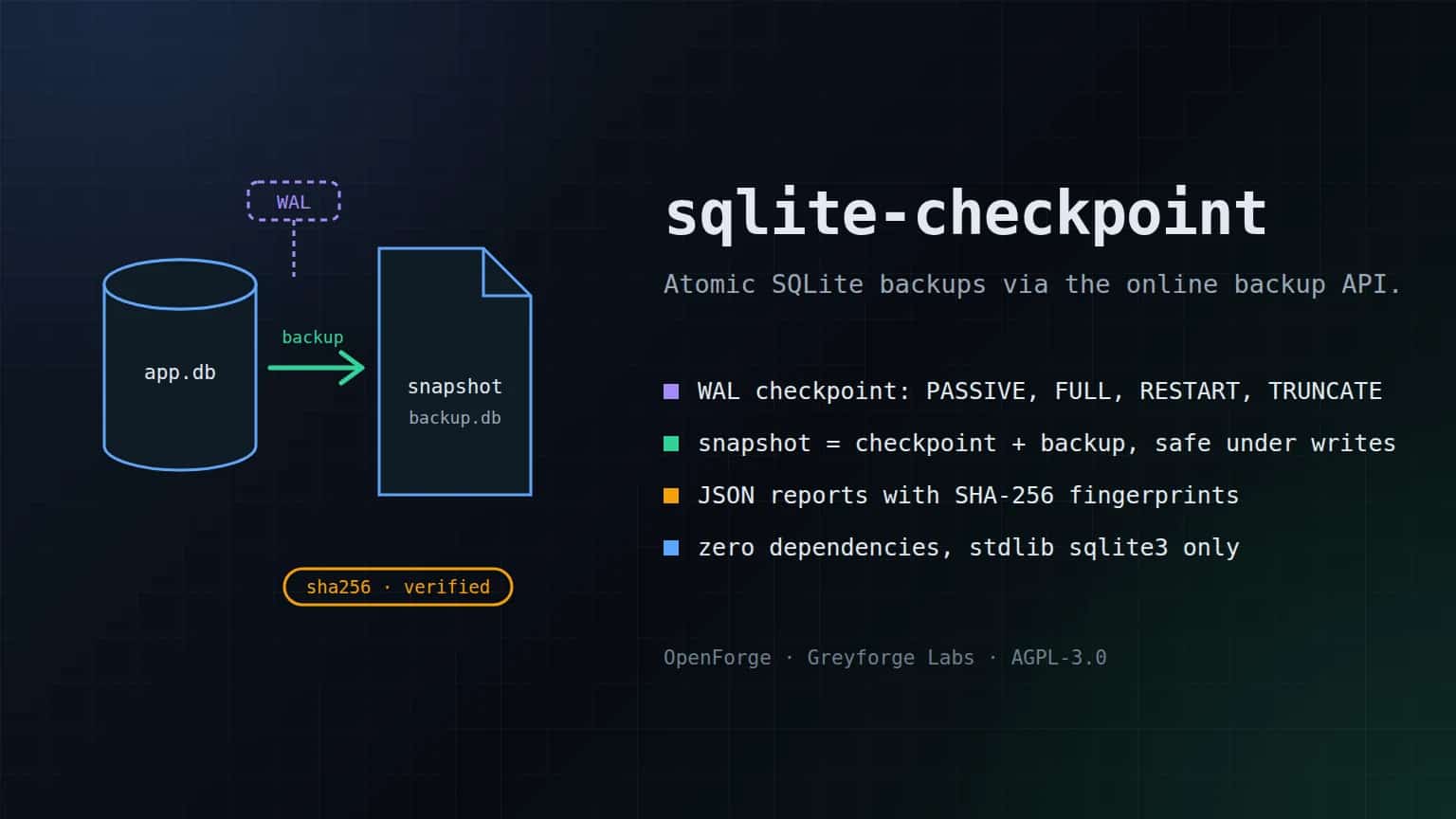
What sqlite-checkpoint v0.1.0 adds to SQLite backup and WAL checkpointing, and what its checksum, destination handling, and reports actually establish.

An early-2026 Greyforge retrospective on building infrastructure to reduce repetitive work, with historical claims separated from measured outcomes.
A chronicle of how Greyforge Labs turned two anonymous machines into one operating fabric with a shared vault, canonical ledgers, and an agent memory plane that resists drift.

A historical two-node coordination account with illustrative ownership, freshness and recovery requirements; it does not establish current topology or universal consistency.

A public preview of Greyforge's structured opposition discipline. An earlier edition was public; the maintained protocol archive and failure checklist now require an unlock.
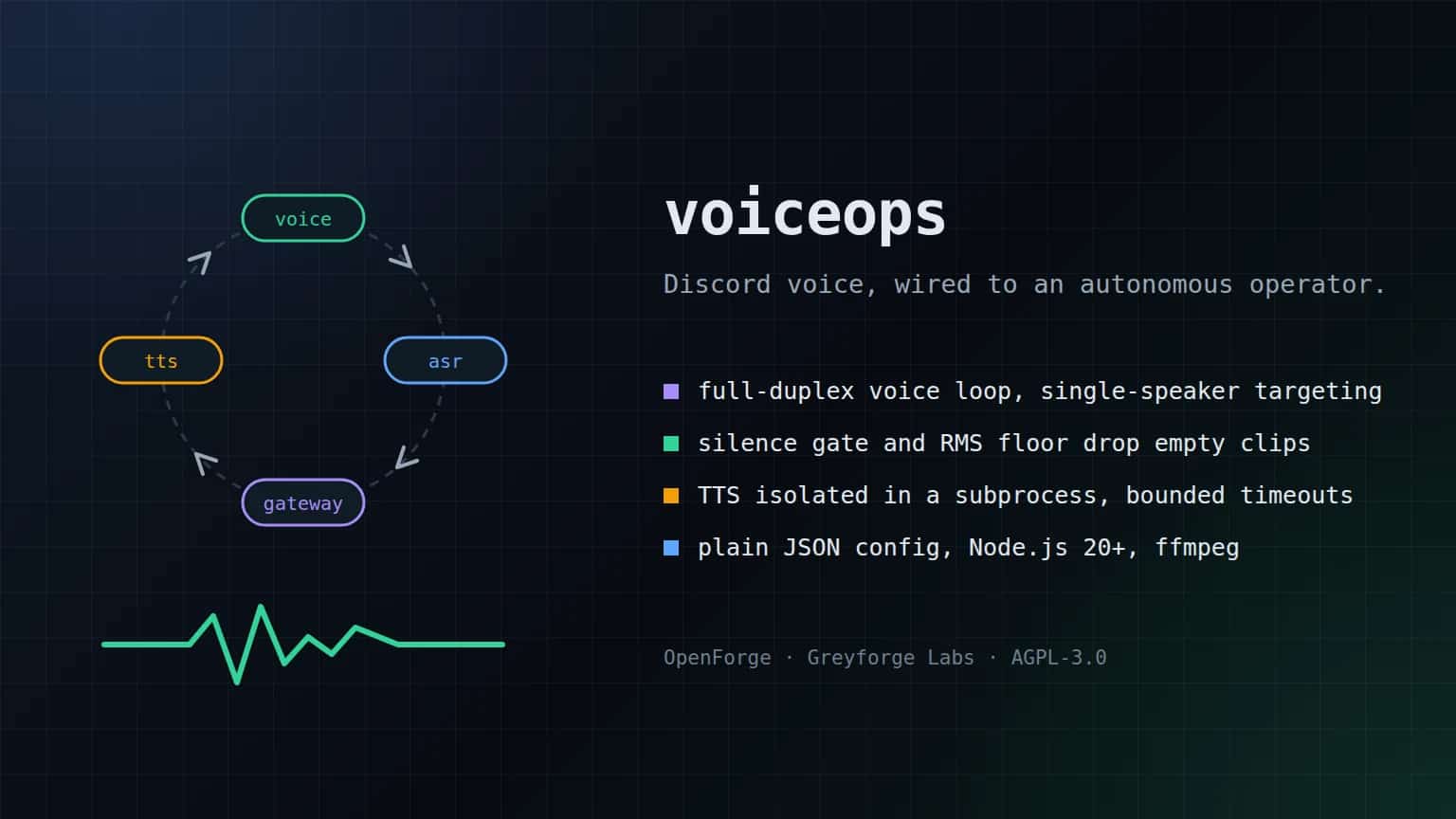
How Greyforge Labs engineered a real-time full duplex voice operations pipeline, validated by adversarial pre-build research and ready for open source release.
A corrected historical account of six coding-agent entries, with a harness rubric and explicit limits on the unpinned source material.

The privacy industry has a structural contradiction: tools that solve data exposure by collecting your data on their servers. ForgeWall is the architectural response - local-first scanning, ephemeral identity, and stealth removal.

Historical account of how ForgeClaw v2 turned into our most instructive failure and why the v3 rebuild clarified what should remain private.

How we built a 162-line Node.js bridge that turns Telegram into a remote terminal for Google Gemini CLI, with streaming, queued access, and an open-source release.

Selected agent research and Greyforge proposals for task contracts, tool boundaries, traces and verification, with no controlled model-swap comparison.

Technical architecture chronicle of the ForgeQuant constraint protocol - how six independent evaluation gates produce deterministic, auditable equity signals.

Independent defensive audit of PicoClaw with a public audit note covering containment, trust boundaries, SSRF exposure, and hardening priorities.

A corrected historical account of a reported Striker persona-change refusal, with unverified dialogue provenance and no claim of autonomous identity persistence.

A public preview of the historical ForgeOps control thesis. An earlier edition was public; the maintained interface-stack and authority record now requires an unlock.

Historical account of a recursive documentation design from the ForgeClaw era; implementation remains unverified.

Historical account of a pipeline designed to generate WebForge Chronicle drafts and invoke a publication path.

A historical account of ForgeClaw project sharding and routing caches, with the withdrawn performance claim and remaining evidence gaps.

A historical ForgeClaw design account: staged coding handoffs, an infrastructure owner, and the implementation evidence that remains unverified.

Historical account of why Greyforge first forked OpenClaw and built ForgeClaw around the Council of Intellect.

Historical profile of the seven specialist personas that powered ForgeClaw during its public chronicle era.